
Practice this guide
Timed holds and releases — follow the rep counter in the mirror.
Face Yoga Guide
Lip Vibration Buzz
Lip Vibration Buzz seals the lips and hums gently through ten three-second cycles for orbicularis oris and light buccinator wake-up. It cues lip-ring awareness without hand contact or full cheek inflation. Skip cracked lips, fresh filler until cleared, or painful TMJ flares.
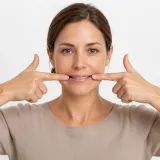
On the cover, the lips stay sealed in a firm horizontal line — the starting landmark for the buzz — with the forehead smooth and gaze calm. From that seal you hum gently so the orbicularis oris and buccinator wake without a full cheek balloon. Different from Cheek Air Puff Hold (full bilateral inflation), Lip Pucker Firming (a forward purse), and Mouth-Corner Index Stretch (indexes on the corners).
Technique
Sit tall at an eye-level mirror. Soften the brows and keep the forehead quiet like the cover. Seal the lips in a firm but comfortable line. Hum or buzz gently through the sealed mouth so the buccinator and orbicularis oris feel a light flutter — not a full cheek balloon. Hold the buzz about three seconds, then release completely for two seconds. Repeat for ten cycles. Keep teeth soft inside and the jaw unlocked. Never over-vibrate until the lips sting or the TMJ complains.
Target muscles
- Primary — Orbicularis oris: the mouth ring seals and micro-vibrates for proprioceptive wake-up; not a deep masseter clench.
- Neighbors — Buccinator may flutter lightly beside the seal; keep inflation minimal unlike a full puff.
- Contrast — Cheek Air Puff fully inflates both cheeks; Lip Pucker loads a forward purse; Mouth-Corner Index Stretch uses hand landmarks on the corners.
- Keep quiet — Frontalis and corrugator (forehead stays smooth like the cover), masseter clamp, and platysma yank. Head-level sealed buzz is the standard.
Posture / setup
Mirror at eye level. Shoulders down. Seal the lips firmly but comfortably before the first buzz — match the cover.
Breathing
Inhale through the nose before each buzz. Exhale into the gentle sealed hum. Release fully between cycles — lips soft.
Teaching cues
Short mirror phrases — calm, specific, easy to repeat between reps.
-
“Seal — then a fine buzz.”
-
“Cheeks barely move.”
-
“Soft teeth inside.”
-
“Forehead stays glass.”
Equipment
- Eye-level mirror
- Optional lip balm after the set
Steps
- Seal the lips in a firm horizontal line — match the cover.
- Buzz or hum gently through the seal for about three seconds.
- Release fully for two seconds; lips soft between cycles.
- Complete ten cycles without inflating into a full cheek puff.
Common mistakes
- Inflating cheeks like Cheek Air Puff instead of a fine buzz
- Biting the lips white-knuckle tight
- Adding a forward pucker that steals the vibration
- Buzzing so hard the TMJ aches
Variations
- Beginner: 6 buzzes of 2 seconds with longer rest
- Standard: 10 buzzes of 3 seconds as coached
- Alternate: one cheek slightly more active, then switch
- Cool-down: lips soft, tongue on the palate for two breaths
Aftercare
- Rest the lips for three soft breaths
- Optional lip balm if the seal felt dry
- Check that the jaw stayed unlocked
- Do not stack another hard perioral isometric next
Benefits
- Wakes lip-ring and light buccal awareness at a desk
- Offers a simple hands-free lip activation
- Pairs well before smile or rounding drills
- Helps interrupt a flat, forgotten-mouth habit
Suitable for
- People who lose lip-ring awareness at a desk
- Beginners wanting a hands-free lip activation
- Anyone pairing lip work with better jaw-unlock habits
- Men and women — mouth width varies; the sealed-buzz cue stays
Not suitable for
- Active cold sores or broken skin on the lips
- Early days after lip filler or perioral procedures until cleared
- Painful TMJ flares that worsen with oral vibration
- Anyone advised against sustained lip sealing
Risks if done incorrectly
- Turning the buzz into a hard cheek balloon
- Clenching teeth inside the seal
- Frowning or raising the brows while buzzing
- Expecting permanent lip volume like injectable filler
Best times
- Morning as a short lip-ring wake-up
- Midday between meetings when the mouth feels flat
- Evening before cheek or smile drills as a gentle primer
- Skip when lips are cracked, freshly injected, or TMJ is flaring
Times to avoid
- During cracked-lip flare days
- Right after aggressive dental or lip work while swollen
- When the jaw hinge is already sore
Results timeline
Realistic checkpoints — form, sleep, and SPF still matter more than any single drill.
-
Lip-ring awareness feels easier after desk hours on most weeks.
-
Rested photos may look a touch more alive around the mouth when sleep is steady.
-
Sealed-buzz form feels automatic. Deep structural changes still need broader care.
-
A maintenance lip-ring set. Supports awareness; does not replace clinical care.
Suggested with this



Avoid in the same session


FAQ
Form cues, safety notes, and how this drill differs from nearby guides.
01 How is this different from Cheek Air Puff Hold?
Cheek Air Puff fully inflates both cheeks. Lip Vibration Buzz keeps a fine sealed hum with minimal cheek movement.
02 How is this different from Lip Pucker Firming?
Lip Pucker loads a forward purse. Here the lips stay in a horizontal seal with a gentle buzz.
03 How is this different from Mouth-Corner Index Stretch?
Mouth-Corner Index Stretch uses indexes on the corners. This drill is hands-free with a sealed buzz.
04 Should my cheeks puff out?
Only slightly. A full balloon means you drifted into Cheek Air Puff — reset to a finer buzz.
05 How loud should the buzz be?
Quiet enough that only you feel it. Neighbors should not hear a motor.
06 Will this plump my lips permanently?
It can improve lip-ring awareness and temporary circulation. Structure and hydration still matter more.
07 How often each week?
Five short sets of about ten buzzes. Quality gentle hums beat daily hard buzzing.
08 After lip filler — allowed?
Only when your injector clears vibration work. Early product days are a skip.
09 My TMJ clicks — fix?
Shorten the buzz, soften the seal, and stop if the hinge complains. This is wake-up, not grind training.
10 Can I buzz through the nose instead?
The drill is a sealed-lip buzz. Breathe through the nose between cycles, not during the hum.
11 Teeth touching inside?
Keep them softly apart. Clenching steals the work from the lip ring.
12 What keeps practice encouraging?
Notice how quickly the mouth feels more awake after a desk block when the buzz stays fine and the forehead stays calm. That quiet wake-up is the win.
Reviews
Share how this guide worked for you. Reviews appear after moderation.
No public reviews yet — be the first to rate this guide.
Write a review
Reviews are moderated before they appear publicly.