
Practice this guide
Timed holds and releases — follow the rep counter in the mirror.
Face Yoga Guide
Lymphatic Cheekbone Dual-Pad Frame
Lymphatic Cheekbone Dual-Pad Frame places light index and middle pads on both upper cheekbones with soft closed eyes for four-second holds across eight reps. It supports gentle midface settle without scraping into the eye socket. Skip open cheek lesions and uncleared cheek procedures.
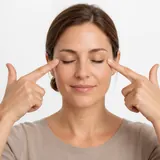
On the cover, both hands place index and middle pads on the upper cheekbones (zygomatic shelf) with fingers pointing upward, remaining fingers softer below, and eyes softly closed. This lymphatic cheekbone dual-pad frame differs from Cheek Dual-Pad Soft Press (two pads on soft mid-cheeks outside the nasolabial folds) and Cheek Finger Lift drills (active lift intent).
Technique
Sit upright. Soften the jaw and close the eyes like the cover. Place the pads of both index and middle fingers on the upper cheekbones just below the outer eye zone—match the cover. Keep remaining fingers soft and pressure about 2/10. Hold four seconds intending a quiet midface settle, not a scrape toward the ears. Release two seconds. Repeat eight holds. Optional: one ultra-light upward-outward micro-glide after the last hold. Never dig into the eye socket or TMJ hinge.
Target muscles
- Primary — soft proprioceptive cue along zygomatic soft tissue under bilateral index–middle pads.
- Neighbors — orbicularis oculi stays quiet; stay off the eyelid.
- Hand cue — index and middle on the upper cheekbone shelf like the cover; other fingers soft.
- Contrast — mid-cheek Dual-Pad Soft Press sits on soft mid-cheeks; Finger Lift adds active lift intent.
- Keep quiet — masseter clamp and shoulder elevation.
Posture / setup
Neutral neck, jaw unlocked, index and middle pads on the upper cheekbones before any hold—match the cover.
Breathing
Inhale as the dual-pad frames settle on both cheekbones. Exhale during the four-second soft hold. Release on a calm inhale.
Teaching cues
Short mirror phrases — calm, specific, easy to repeat between reps.
-
"Index and middle on the cheekbone shelf."
-
"Two out of ten—settle, don't scrape."
-
"Stay below the eye socket."
-
"Four-second calm hold."
Equipment
- Clean hands
- Optional thin cream for comfort
Steps
- Sit tall and soften jaw and shoulders.
- Place index and middle pads on the upper cheekbones as on the cover.
- Hold four seconds with about 2/10 pressure.
- Release two seconds and repeat eight times.
Common mistakes
- Dropping pads onto soft mid-cheek only (mid-cheek Dual-Pad placement)
- Using full palms like a palm lift
- Hiking the shoulders
- Pushing so hard the bone aches
Variations
- Beginner: 5 holds of 3 seconds
- Standard: 8 holds of 4 seconds
- Sensitive day: contact only, almost no press
- Finish: one soft upward-outward micro-glide
Aftercare
- Remove the hands and soften the midface
- Blink gently and take two breaths
- Optional one light temple rest
- Avoid stacking a hard cheek lift next
Benefits
- Improves cheekbone placement awareness
- Supports low-load midface settle habits
- Uses a clear bilateral two-pad landmark
- Complements under-eye lymph work on separate days
Suitable for
- People wanting a clear cheekbone lymph landmark
- Beginners who prefer a clear two-pad zygomatic frame
- Users pairing under-eye and cheek soft work across the week
- Adults seeking low-load midface settle
Not suitable for
- Open lesions on the zygomatic contact path
- Early days after cheek procedures without clearance
- Acute sinus pain worsened by cheek pressure
- Anyone advised to avoid midface pressure
Risks if done incorrectly
- Pressing into the eye socket rim
- Hard scraping toward the ears
- Jaw clench under closed eyes
- Holding breath
Best times
- Morning midface puffiness settle
- Midday cheek-shelf reset after screens
- Evening low-load cool-down
- Skip on irritated cheekbone skin days
Times to avoid
- During active cheek breakouts under the pads
- Right after aggressive peels or microneedling
- When the area is bruised or freshly injected
Results timeline
Realistic checkpoints — form, sleep, and SPF still matter more than any single drill.
-
Cheekbone frame placement becomes clearer and lighter.
-
Less midface gripping after screens for many users.
-
Steadier low-load midface pacing.
-
Reliable maintenance frame for gentle cheek soft-tissue hygiene.
Suggested with this

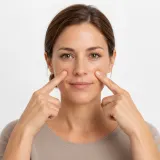
Avoid in the same session



FAQ
Form cues, safety notes, and how this drill differs from nearby guides.
01 How is this different from Cheek Dual-Pad Soft Press?
Mid-cheek Dual-Pad Soft Press uses two pads on the soft mid-cheeks outside the nasolabial folds. This drill places index and middle pads on the upper cheekbone shelf.
02 How is this different from Cheek Finger Lift?
Finger Lift emphasizes an active lift cue. This drill prioritizes a quiet lymph-style settle with feather-to-light contact.
03 Will this drain puffiness overnight?
It may support comfort habits; visible puffiness change varies and is not guaranteed.
04 How hard should I press?
About 2/10. Bone ache means you are too hard.
05 Can beginners start here?
Yes. The two-pad cheekbone frame is easy to match from the cover.
06 Should my eyes stay closed?
Soft closed eyes match the cover; open lightly if you need visual placement checks first.
07 How often weekly?
About four short sessions weekly is enough for most users.
08 Where exactly on the cheek?
On the upper cheekbone shelf below the outer eye zone—not on the soft mid-cheek belly and not on the eyelid.
09 When should I skip?
Skip during open acne under the pads, acute sinus tenderness, or uncleared cheek procedures.
10 Can I pair it with under-eye lymph massage?
Prefer separate days so periocular and cheek pressure do not stack heavily.
11 Should I scrape toward the ears?
No. Hold first; optional finish is one ultra-light micro-glide only.
12 How do I stay motivated?
Track a softer midface feel after desk blocks—small consistency wins matter.
Reviews
Share how this guide worked for you. Reviews appear after moderation.
No public reviews yet — be the first to rate this guide.
Write a review
Reviews are moderated before they appear publicly.