
 Forehead
Forehead Brow Raise & Release
This drill matches the cover exactly: brows lifted high toward the hairline, eyes opened w...
Read guideFace Yoga Library
Practical face yoga exercises from the prmta library — clear steps, safety notes, and expected results.
Forehead
This drill matches the cover exactly: brows lifted high toward the hairline, eyes opened w...
Read guide Forehead
Forehead Massage is a light-pressure glide for the frontalis—the broad muscle that lifts t...
Read guide Forehead
The still cover freezes the landing shape — not a mid-strike freeze-frame: three flat fing...
Read guide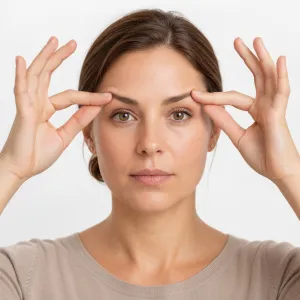 Eyebrows
Eyebrow Lift is an isometric brow drill that matches the cover: index finger rests just ab...
Read guide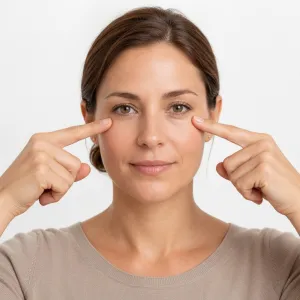 Eyebrows
On the cover, both index fingertips rest just under the outer corners of the eyes on the l...
Read guide Cheeks
Cheek Lift is a mid-face strengthening move that matches the cover: an open smile so the c...
Read guide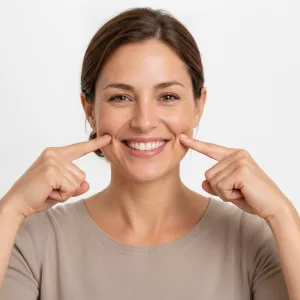 Cheeks
On the cover, the smile is open and bright while both index fingers rest at the outer corn...
Read guide Lips
Lips
Air Kiss trains the orbicularis oris—the ring of muscle around the mouth—with a controlled...
Read guide Lips
Lips
The cover shows a firm forward lip pucker — head level, eyes calm, forehead smooth, lips p...
Read guide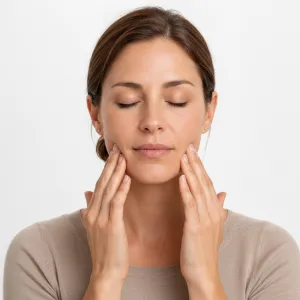 Jawline
Jawline Massage is a moderate-pressure glide along the lower face. Start where the cover s...
Read guide Jawline
The cover shows the classic kiss-the-ceiling shape: head tipped gently back, lips pursed a...
Read guideIn clinic and studio settings, face yoga is treated as motor training for expression muscles plus light soft-tissue work. The aim is cleaner on–off control and less habitual bracing — not a redesign of bone. The notes below reflect how experienced teachers set expectations with adult clients.
No governing body keeps a master list. When instructors tally named drills across method books, studio syllabi, and large apps, the usual range is roughly 550–750 entries. Plenty of those names describe the same motor pattern under different branding. The table below pairs those rough worldwide ranges with the curated count published here.
Mostly frontalis work: lift-and-release, tapping, and light midline-to-temple glides when the brow line stays “on” all day.
Pinned brow lifts and orbital-rim work. The usual coaching cue is height under the arch without stacking forehead lines.
Zygomaticus-led smile holds and corner feedback. Mid-face height without biting down or forcing an eye squint.
Orbicularis oris puckers, seals, and short isometric holds. Useful when the mouth corners collapse or the lip ring feels slack.
Masseter release, mandible sweeps, and under-chin lengthening. Often the busiest zone in people who clench at screens.
Worldwide ranges are working estimates for orientation, not a formal census. Library counts change when new guides are published.
A typical drill asks for voluntary recruitment — frontalis for brow height, orbicularis oculi around the eye, zygomaticus for the cheek apple, orbicularis oris for the lip ring, masseter and related jaw muscles along the mandible — then a deliberate release. Massage variations add superficial glide to warm tissue that has been braced for hours. The skill that matters most is not the hold itself; it is returning the face to a quieter rest.
Clients usually report warmth, easier brow release after screen work, and a jaw that unlocks more readily before they report any contour change. Soft-tissue appearance can shift gradually with consistent practice, but sleep, dental factors, body-weight change, sun damage, and age still dominate the picture. Facial exercise complements dermatology and dental care; it does not replace them.
People use “younger” as shorthand for several visual cues: a calmer forehead at rest, clearer jaw edge in certain light, fuller mid-face height, less tired eye aperture. Muscle control and massage can influence some of those cues. Collagen quality, hormones, and genetics set hard limits that no facial isometric will erase.
Mood effects show up mainly as reduced clenching and a short, embodied routine that interrupts stress bracing. That sits in the same family as exercise psychology, not as a psychiatric treatment. Teachers who built large method libraries — Fumiko Takatsu in Japan; Annelise Hagen and Danielle Collins in the English-speaking market — tend to coach restraint: light load, full release, no grimacing for social video.
Warmth and easier release often appear within a handful of sessions. Changes in resting expression, when they occur, are more commonly judged after four to eight weeks of near-daily work, with a fairer review around three months. Two weeks is usually enough to learn clean form; one month builds habit; three months answers whether the mirror change justifies continuing.
Starting pattern matters. A forehead that ladders from desk posture may quiet faster with release work than a long-standing under-chin softness responds to chin lifts alone. Same-light, same-angle photos beat daily mirror checking.
Most healthy adults tolerate gentle isometrics and light massage. Delay or clear with a clinician when there is active facial dermatitis, open wounds, recent injectables or surgery (follow the treating clinician’s timeline), sharp TMJ pain, acute sinus infection, or any drill that reproduces significant pain. Neuromuscular disease and facial palsy histories need individualized advice before loading expression muscles.
“Beginner” in this catalog means short holds and moderate effort. It does not mean every face will tolerate every drill. Stop for headache, tooth pain, eye strain, or dizziness.
The muscle map is the same. Habit patterns differ. Men who clench often need more masseter release before strengthening work feels clean. Women who chase mid-face lift or brow calm are usually training the same zygomaticus and frontalis pathways with different starting grip.
Children and younger teens do not need anti-aging facial sculpting. Orofacial work for a child belongs with a clinician when there is a functional reason — mouth breathing, tension habits, posture — not with social-video challenges. This library is written for adults.
Most adults do well with 8–20 focused minutes on most days: one or two zones, clean form, full release between reps. Stacking every trending drill in one sitting usually increases gripping rather than tone. Eight precise brow raises with a soft jaw outperform thirty messy ones.
Morning practice fits beside skincare. Evening practice fits jaw and forehead release after cognitive load. Two ten-minute sessions beat one abandoned forty-minute block.
Motor patterns and tension habits fade without practice, the same way neck mobility fades when you stop. A weekend session can still reduce bracing for a day or two. Contour and resting-tone goals need frequency.
Three clean sessions a week keep awareness. Five or six sessions a week is the range where durable mirror changes are most often reported. After a long gap, restart short rather than overloading.
European facial gymnastics and mid-century soft-tissue schools already treated the face as trainable tissue. Fumiko Takatsu’s Face Yoga Method gave the work a clear consumer syllabus in Japan. In English-language markets, Annelise Hagen and Danielle Collins (among others) framed it as accessible fitness through books and classes. Related facial-fitness traditions also circulated in Russian and German-speaking wellness cultures.
The densest consumer scenes today include Japan and South Korea, large digital audiences in India and Southeast Asia, and steady studio/app uptake in the United States, United Kingdom, Germany, Brazil, and parts of the Middle East. The dominant format is short, front-facing drills — the same format used in this library.
Camera-based coaching can catch a brow that climbs into forehead ladders, a smile that over-recruits the eye squint, or a jaw that clamps during a cheek hold. Scheduling tools can order zones by available minutes. Those are delivery aids. They do not invent new anatomy.
The useful standard remains the same as in a live class: clear form, sensible dose, and stop rules. On prmta, the exercise catalog — steps, safety notes, zone logic — stays editorial. Tech helps with consistency; it should not override pain signals or clinician limits.
Answers in the same language used in intake and first-session coaching.
No. Soft-tissue resting tone and expression control can change how the face reads in photos and mirrors. Bone geometry does not. Expect subtler shifts in brow calm, cheek height cues, and jaw ease — not a new skeletal frame.
Compared with dermatologic interventions, large controlled trials are still limited. Some protocols show better muscle engagement and participant-perceived firmness. “Reverses aging” is marketing language. Instructors frame results as training adaptations and less chronic grip.
Warmth and easier release often within days. Resting-face changes, when they appear, commonly take four to eight weeks of regular practice. Three months of consistent photos is a fair review point.
Eight to twenty focused minutes on most days is enough for most adults. One or two zones, clean reps, full release. Longer chaotic sessions are usually less effective.
The anatomy is shared. Programming differs by habit: more jaw release for heavy clenchers; more brow or mid-face emphasis when those are the goals. Adjust load and recovery, not the muscle map.
No. This library is for adults. Any orofacial work for a child should come from a qualified clinician for a functional reason, not from appearance challenges online.
You may still feel short-term relaxation. Contour and resting-tone goals need more frequency. Three solid sessions weekly maintain skill; five or six are typical for durable visible change.
Often indirectly: less facial bracing and a short completed ritual support adherence. It is not a treatment for depression or anxiety disorders. Keep clinical care in place when those are present.
Skip or get clearance with active skin infection, open facial wounds, recent injectables or surgery, sharp TMJ pain, acute sinus issues, or any drill that causes significant pain, headache, or dizziness.
It grew from older facial gymnastics and soft-tissue traditions, then reached wide consumer form through teachers such as Fumiko Takatsu in Japan and Western instructors including Annelise Hagen and Danielle Collins. Strong scenes today include Japan, South Korea, India, the US, the UK, Germany, Brazil, and large online communities.